

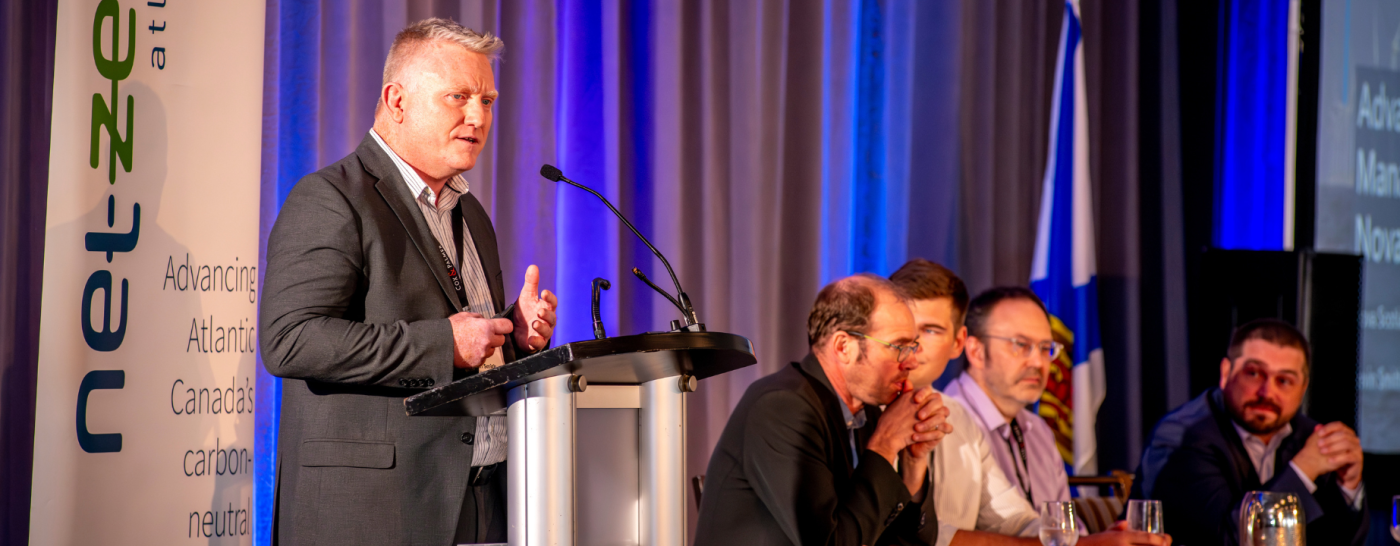
On September 24th 2025, 295 people gathered at the Westin Nova Scotian in Halifax for the second Nova Scotia Offshore Wind R&D Forum. Attendance rose 11 percent over the year before, a clear sign of the momentum building across the region's offshore wind sector.
Over one full day, researchers, policymakers, industry experts, and community members shared results and worked through the knowledge gaps that still stand between ambition and action. The Forum featured 2 keynotes, 9 panel discussions, 43 speakers, and 8 poster presenters, with 14 percent of speakers joining from international jurisdictions.
While early-bird registration is open for the 2026 Atlantic Canada Offshore Wind Readiness Forum, we wanted to highlight takeaways that stood out across last year’s three Forum streams.
Technical Sessions
- Purpose-built ports are a precondition for scale. Joshua Singer of Moffatt & Nichol presented a screening of Atlantic Canadian ports and identified candidates for primary offshore wind hubs. His team’s analysis showed that ports need to be purpose-built to handle large fixed and floating components, that high-cost expansions are required before turbine installation, and that public funding and revenue backstops will likely be needed to bridge financing gaps. → View Joshua Singer’s presentation
- Siting and grouping can raise grid value. Nathaniel Pearre of Dalhousie University presented modelling of potential wind farms in Nova Scotia waters. He found that bottom-mounted turbines in depths shallower than 55 metres can reach capacity factors as high as 65 percent, and that grouping sites together smooths output and reduces curtailment. → View Nathaniel Pearre’s presentation
- Coastal conditions are hard on turbine blades. Marianne Rodgers of the Wind Energy Institute of Canada shared operational findings on onshore wind turbine blades in coastal environments. Field trials of most protective solutions failed within two to three years, with pitting, peeling, and cracking, which she linked to a need for improved materials, better installation, and stronger monitoring data. → View Marianne Rodgers’s presentation
Environmental Sessions
- Baseline ocean data is the gap to close before construction. Hilary Moors-Murphy of Fisheries and Oceans Canada presented a new initiative using passive acoustic and oceanographic moorings across the Scotian Shelf. She noted that fine-scale data on marine mammal presence is currently limited, and that closing this gap through collaboration and shared datasets is important before construction begins. → View Hilary Moors-Murphy’s presentation
- Impact assessment practice lags what regulations expect. Celesa Horvath of Ventus Development Services shared results from a national survey on impact assessment in Canada. Respondents highlighted opportunities to strengthen clarity around significance criteria, a lack of established thresholds, and better align regulatory expectations with what an assessment can realistically deliver, all of which point to a need for clearer, more practical guidance. → View Celesa Horvath’s presentation
- Ecosystem-scale modelling matters in complex waters. Kaustubha Raghukumar of Integral Consulting presented modelling of the potential hydrodynamic effects of offshore wind across scales, from individual turbines to regional circulation, including cascading effects on the marine food web. The work concluded that a comprehensive, multi-tool modelling approach is important when assessing sensitive marine environments. → View Kaustubha Raghukumar’s presentation
Policy and Regulatory Sessions
- Public understanding is still taking shape. Brenden Sommerhalder of MQO Research presented findings from two studies on how Nova Scotians view renewable energy. The research found a generally low self-assessed understanding of the topic, 51 percent support for new renewable energy developments, and roughly 30 percent of the population identified as convertible, meaning that they are open to supporting developments if more information is provided. → View Brenden Sommerhalder’s presentation
- Rural social infrastructure will feel the transition. M.N. Tighsazzadeh of Simon Fraser University presented research on an equitable energy transition in Nova Scotia. The work identified gaps in social infrastructure, particularly in healthcare and access to essential services, that could affect rural communities as the offshore wind sector grows. → View M.N. Tighsazzadeh’s presentation
- Other regions offer lessons in coexistence. Hannah MacDonald of the Gulf of Maine Research Institute shared lessons from fisheries engagement in the United States. Drawing on work in Maine, she pointed to the value of building trust early, meeting people in accessible community settings, and using approaches such as gear-compatibility studies, compensation frameworks, and pilot projects to support coexistence. → View Hannah MacDonald’s presentation
Looking ahead
The 2025 Forum showed how much is possible when sectors connect around a shared purpose. The 2026 Atlantic Canada Offshore Wind Readiness Forum builds on that foundation, widening the conversation across the region as Atlantic Canada moves toward development readiness.
Early-bird tickets are available for a limited time, until end of day July 8.
Register Now to join us September 16, 2026 at the Four Points by Sheraton Halifax.